SoC (the chip)
The silicon defines the CPU, radios, security and peripherals. It needs flash, power, RF and support circuitry unless those are built into the package.
Choose this when: You are designing a high-volume, RF-validated product.
Choose the right ESP32 board with an interactive family comparison, 13 student projects, official specifications, and a beginner-friendly custom-PCB schematic guide.
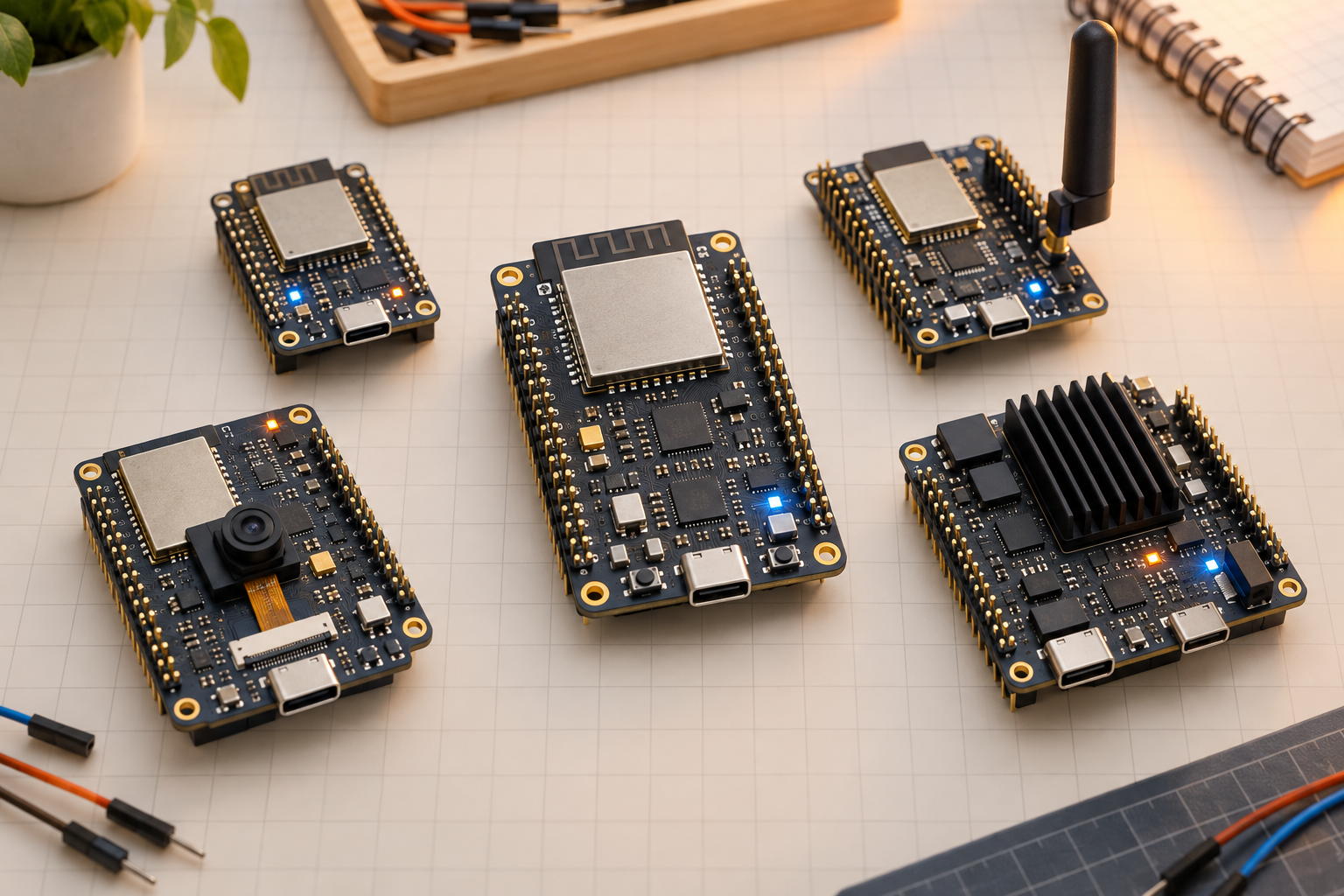
A lot of “which ESP32?” confusion disappears once you know what you are actually buying.
The silicon defines the CPU, radios, security and peripherals. It needs flash, power, RF and support circuitry unless those are built into the package.
Choose this when: You are designing a high-volume, RF-validated product.A module combines the SoC with flash, often PSRAM, a crystal and a certified antenna/RF design. It is the sensible starting point for a first custom PCB.
Choose this when: You want a custom board without designing the 2.4/5 GHz radio section.A dev kit adds USB, regulation, reset/boot buttons and headers around a chip or module so you can learn and prototype immediately.
Choose this when: You are learning, testing firmware or wiring sensors on a breadboard.There is no universal “best ESP32.” Answer four questions and the guide will rank a recommendation and runner-up, including the trade-off you should understand before buying.
Use the tabs to see what each family optimizes. The board name matters: memory, connector and pin availability change between dev-kit variants.
The compatibility champion for classic tutorials and Bluetooth Classic.
The largest body of examples and the only board in this shortlist with mature Bluetooth Classic support.
Older radio/security generation, no native USB, Wi-Fi 6 or 802.15.4.
A many-pin Wi-Fi and native-USB specialist.
Native USB, 43 programmable GPIOs, touch inputs and two DAC channels make it unusually flexible for interfaces.
No Bluetooth and only one main CPU core.
The best student all-rounder for camera, voice, USB and TinyML.
PSRAM board options plus vector instructions accelerate neural-network and signal-processing workloads.
No Bluetooth Classic, Wi-Fi 6 or Thread/Zigbee radio.
A compact, economical choice for simple connected products.
Small silicon, low cost and enough Wi-Fi/BLE capability for focused high-volume devices.
Only 14 GPIO and a deliberately smaller peripheral/security feature set.
The easiest modern, low-cost RISC-V starting point.
A balanced combination of price, modern RISC-V tools, Wi-Fi/BLE and strong security.
No Bluetooth Classic, 802.15.4 or general USB host/device peripheral.
The choice when 5 GHz and the broadest wireless mix matter.
Only family in this core guide combining 5 GHz Wi-Fi 6, BLE and Thread/Zigbee-class 802.15.4.
Newer ecosystem; shared radio resources require deliberate coexistence design.
The clearest single-board path into Wi-Fi 6, Matter and Thread.
Wi-Fi, BLE commissioning and Thread/Zigbee-class radio coexist in one affordable learning board.
No 5 GHz; the three radios share one RF system and are not three independent links.
A low-power Thread/Zigbee endpoint—not a Wi-Fi board.
Avoids Wi-Fi overhead and focuses on efficient BLE plus 802.15.4 mesh connectivity.
Needs a Thread border router or Zigbee coordinator to reach wider networks.
A high-performance multimedia processor that needs a companion radio.
Dedicated camera/display, image, video and pixel-processing hardware far beyond a normal MCU dashboard.
Not a simple wireless MCU; higher cost/complexity and wireless comes from a companion chip.
Filter the matrix by level or must-have feature. Cost tiers compare relative dev-kit complexity, not live shop prices.
Showing all 9 boards
| Board | CPU | Wireless | USB | Best for | Trade-off | Level / cost |
|---|---|---|---|---|---|---|
| Original ESP32ESP32-DevKitC V4 | Xtensa LX6, up to 2 cores · 240 MHz | 2.4 GHz Wi-Fi 4 · Bluetooth 4.2 Classic + BLE | USB-to-UART bridge; no native USB | Legacy Arduino lessons, Bluetooth Classic audio, motors and broad library compatibility | Older radio/security generation, no native USB, Wi-Fi 6 or 802.15.4. | Beginner$ |
| ESP32-S2ESP32-S2-DevKitC-1-N8R2 | Single-core Xtensa LX7 · 240 MHz | 2.4 GHz Wi-Fi 4 · no Bluetooth | Full-speed USB OTG | USB devices, capacitive-touch controls, large GPIO projects and Wi-Fi interfaces | No Bluetooth and only one main CPU core. | Intermediate$$ |
| ESP32-S3ESP32-S3-DevKitC-1-N8R8 | Dual-core Xtensa LX7 · 240 MHz · vector instructions | 2.4 GHz Wi-Fi 4 · Bluetooth 5 LE | USB OTG + USB Serial/JTAG | Computer vision, offline voice, displays, USB devices and wireless controllers | No Bluetooth Classic, Wi-Fi 6 or Thread/Zigbee radio. | Intermediate$$ |
| ESP32-C2 / ESP8684ESP8684-DevKitM-1 v1.1 | Single-core 32-bit RISC-V · 120 MHz | 2.4 GHz Wi-Fi 4 · Bluetooth 5 LE | USB-to-UART bridge on the dev kit; no native USB OTG | Smart bulbs, smart plugs and small low-data-rate sensors | Only 14 GPIO and a deliberately smaller peripheral/security feature set. | Intermediate$ |
| ESP32-C3ESP32-C3-DevKitM-1 | Single-core 32-bit RISC-V · 160 MHz | 2.4 GHz Wi-Fi 4 · Bluetooth 5 LE | USB Serial/JTAG, not general USB OTG | First IoT projects, battery sensors, BLE provisioning and simple connected controls | No Bluetooth Classic, 802.15.4 or general USB host/device peripheral. | Beginner$ |
| ESP32-C5ESP32-C5-DevKitC-1 v1.2 | HP RISC-V · 240 MHz + LP RISC-V · 48 MHz | 2.4/5 GHz Wi-Fi 6 · BLE · 802.15.4 | USB Serial/JTAG; no general USB OTG | Dual-band gateways, lower-interference telemetry, Matter hubs and CAN FD systems | Newer ecosystem; shared radio resources require deliberate coexistence design. | Advanced$$ |
| ESP32-C6ESP32-C6-DevKitC-1 | HP RISC-V · 160 MHz + LP RISC-V · 20 MHz | 2.4 GHz Wi-Fi 6 · Bluetooth 5 LE · 802.15.4 | USB Serial/JTAG; no general USB OTG | Matter-over-Wi-Fi or Thread, Zigbee experiments and congested 2.4 GHz IoT networks | No 5 GHz; the three radios share one RF system and are not three independent links. | Intermediate$$ |
| ESP32-H2ESP32-H2-DevKitM-1 | Single-core 32-bit RISC-V · 96 MHz | Bluetooth 5 LE · 802.15.4 · no Wi-Fi | USB Serial/JTAG; no general USB OTG | Battery Thread/Zigbee sensors, buttons, locks and low-power mesh endpoints | Needs a Thread border router or Zigbee coordinator to reach wider networks. | Intermediate$$ |
| ESP32-P4 / P4XESP32-P4X-C5-Function-EV-Board | Dual HP RISC-V · 400 MHz + LP RISC-V · 40 MHz | No integrated radio; selected board adds an ESP32-C5 companion | USB 2.0 High-Speed + Full-Speed | MIPI cameras/displays, rich HMI, video, edge vision, Ethernet and high-speed USB | Not a simple wireless MCU; higher cost/complexity and wireless comes from a companion chip. | Advanced$$$ |
Important: “ESP32” is a family name, not a promise that every member has Wi-Fi and Bluetooth. S2 has no Bluetooth, H2 has no Wi-Fi, and P4 has no integrated radio.
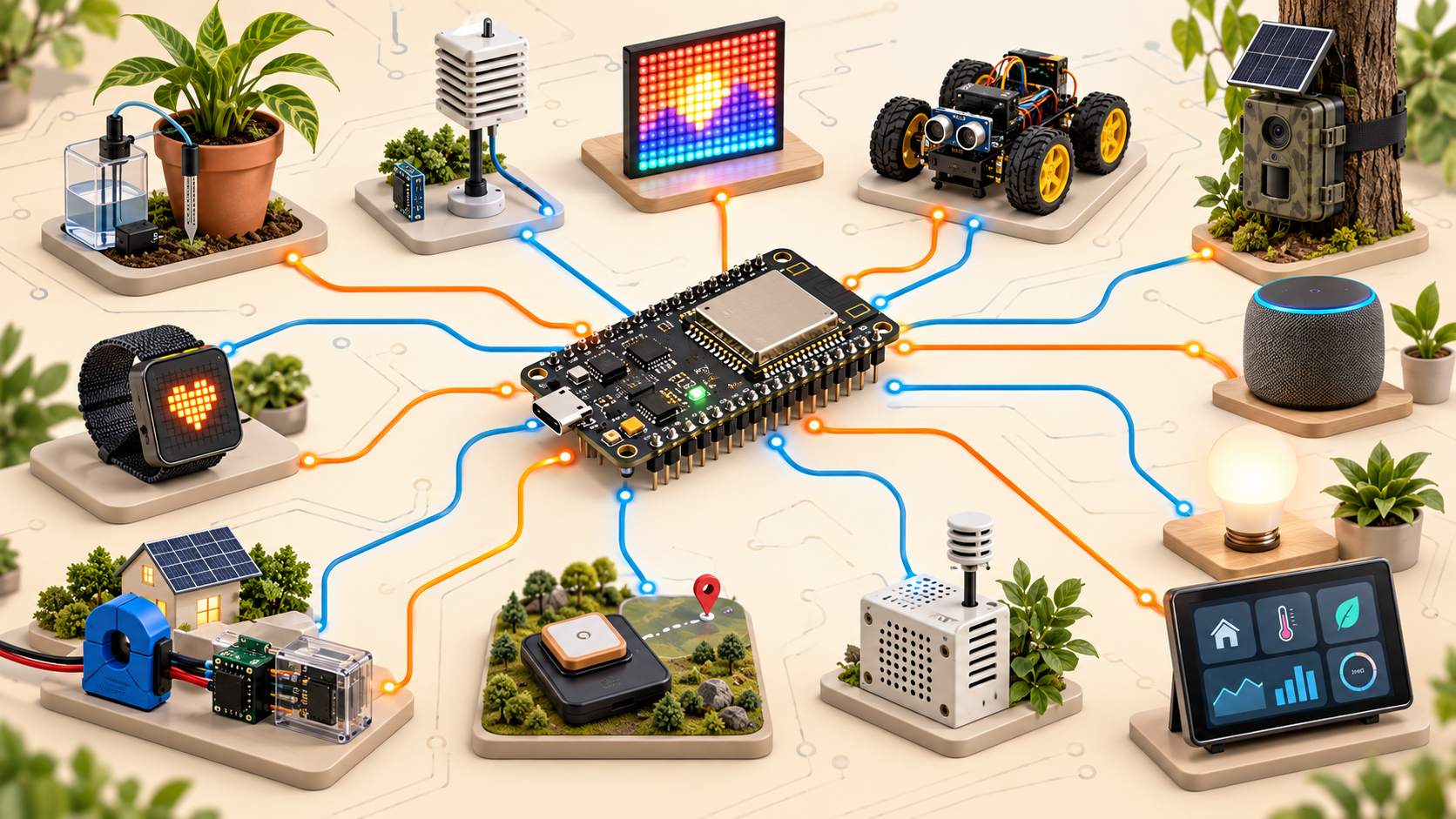
Every idea includes a learning advantage, realistic time band and the reason its recommended board is a better fit.
Showing all 13 projects
Host a tiny responsive control page directly on the board and switch or dim an LED.
It is inexpensive, modern and has more than enough Wi-Fi performance for a first local web server.
Students learn GPIO, PWM, HTTP and a complete device-to-browser loop without a cloud account.
Wake periodically, measure temperature and humidity, upload the reading, then sleep again.
C3 is a lean connected sensor platform; C6 adds Wi-Fi 6 Target Wake Time experiments.
Introduces real battery budgeting, wake sources and resilient sensor telemetry.
Control a low-voltage lamp locally over Wi-Fi and add BLE provisioning.
This focused, economical chip was designed for simple high-volume connected products.
Shows how a compact production-style MCU can deliver a useful product with minimal unused hardware.
Safety: Use low-voltage DC only; do not switch mains voltage on a classroom breadboard.
Receive audio from a phone and play it through an I2S amplifier and speaker.
Classic Bluetooth A2DP is the defining advantage of the original ESP32 in this shortlist.
Combines wireless profiles, I2S audio and buffering using a huge library ecosystem.
Build a programmable keyboard that sends shortcuts to a computer over native USB.
Both have native USB; S2 adds abundant touch/GPIO while S3 adds BLE for a wireless mode.
No second USB interface MCU is required, keeping the hardware and firmware easier to understand.
Read knobs, buttons and pads, then send expressive controls over USB or Bluetooth LE.
S3 combines native USB, BLE and dual-core processing for responsive input scanning.
One board teaches two transport methods while leaving headroom for filtering and display feedback.
Capture small camera frames and run an on-device image classifier without sending images to the cloud.
The N8R8 variant supplies frame-buffer PSRAM while S3 vector instructions accelerate inference kernels.
A practical introduction to private edge AI, camera pipelines and model-size trade-offs.
Detect a wake word and a small command set locally, then control LEDs or a low-voltage appliance model.
Vector/DSP acceleration, I2S, PSRAM options and dual cores fit audio front ends and compact models.
Works without streaming microphone audio to an external service and exposes real latency constraints.
Commission a real Matter accessory and compare Matter over Wi-Fi with Matter over Thread.
C6 places 2.4 GHz Wi-Fi 6, BLE commissioning and 802.15.4 on one approachable board.
Students can explore modern interoperable smart-home networking without changing hardware.
Report a magnetic reed switch state through a low-power mesh network.
H2 spends its silicon and energy budget on BLE plus 802.15.4 instead of Wi-Fi.
Excellent for learning sleepy end devices, mesh roles and long-lived sensor design.
Use a host MCU and a dedicated 802.15.4 radio coprocessor to bridge a small sensor network.
Separate application and radio processors make the architecture visible and easier to profile.
Teaches real gateway boundaries, commissioning, coexistence and failure handling.
Combine camera capture, local image processing, display/audio and dual-band networking.
P4 handles the multimedia pipeline while the companion C5 supplies 2.4/5 GHz Wi-Fi 6 and BLE.
Demonstrates a scalable multi-processor product architecture instead of forcing one MCU to do everything.
Bridge robot telemetry from CAN FD to a lower-interference 5 GHz network.
C5 combines dual-band Wi-Fi 6 with two CAN FD controllers.
Keeps crowded 2.4 GHz spectrum available for other devices while teaching robust field-bus integration.
Safety: Develop on a current-limited bench setup before connecting to a powered robot.
No projects match those filters. Reset the filters or broaden your board choice.
This reference uses an ESP32-WROOM-32E module so the difficult RF matching, crystal and flash are already solved inside the module.
Recreate the circuit in KiCad, then run ERC/DRC, check every footprint against the supplier datasheet, and compare the finished design with Espressif’s latest module and DevKitC files before ordering boards.
Espressif’s DevKitC V4 files are the authority for the classic board and its reset truth table.
This original teaching circuit keeps the official reset topology while updating the connector and bridge. It must be independently verified.
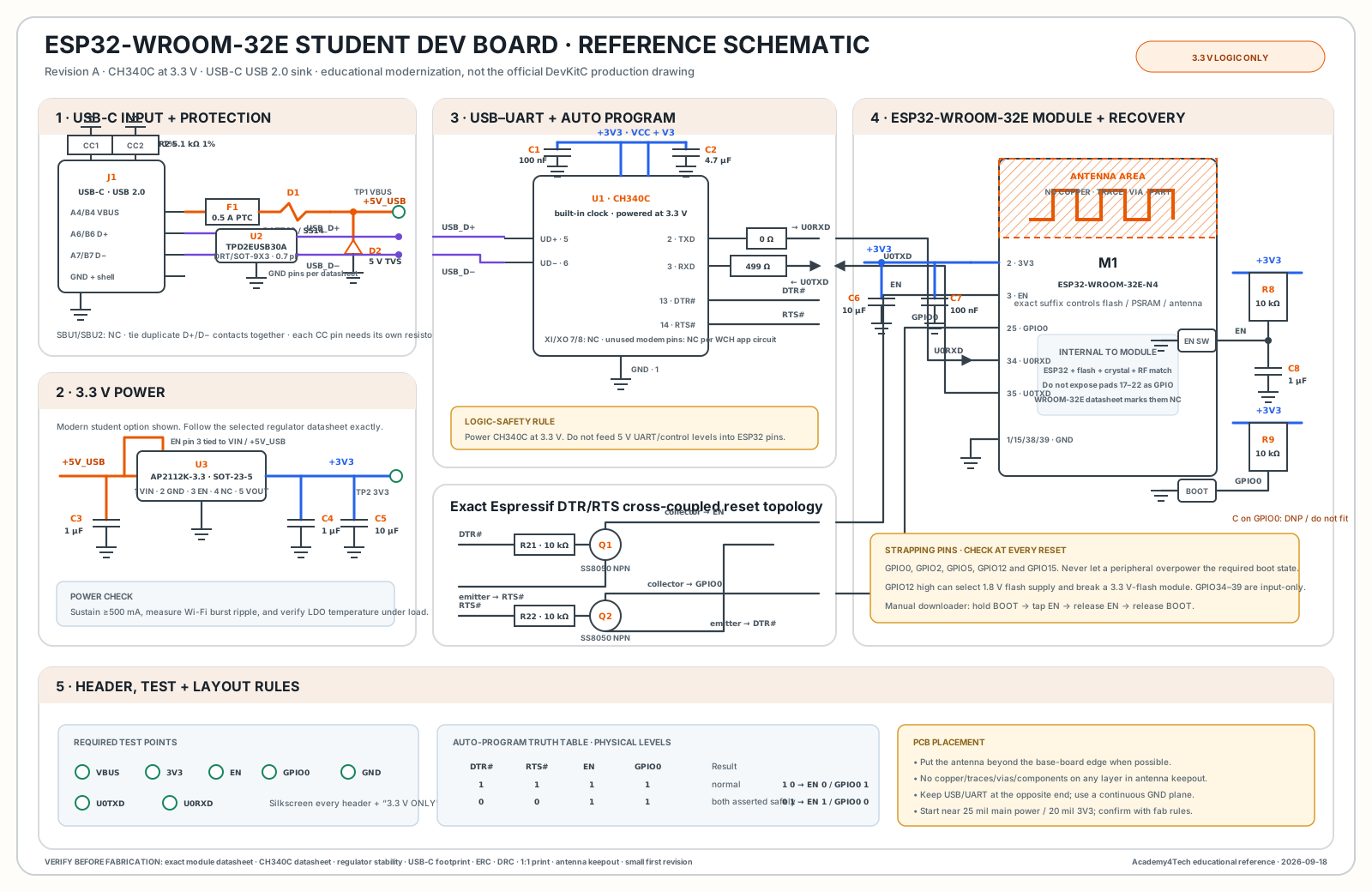
Open or download the SVG to zoom without losing label clarity. The circuit is intentionally divided into blocks that match the explanations below.
Espressif recommends a 3.3 V supply capable of at least 500 mA, ESD protection and at least 10 µF at the power entrance.
Use the exact CH340C datasheet for supply and decoupling rules; clone the official DevKitC reset truth table rather than improvising it.
Pin rules change across ESP32 families. This schematic is specifically for ESP32-WROOM-32E—not S3, C3, C6, H2 or P4.
A two-layer learning board can work with a module; four layers give a more controlled ground/power structure. Follow the module placement drawings exactly.
| Block | Reference choice | Verify before ordering |
|---|---|---|
| Module | ESP32-WROOM-32E-N4 | Exact suffix, antenna type and footprint land pattern |
| USB/UART | CH340C + USB-C USB2 receptacle | CH340C package/supply rules and receptacle pin numbering |
| 3.3 V | AP2112K-3.3 SOT-23-5 or equivalent ≥500 mA LDO | VIN/GND/EN/NC/VOUT pin order, capacitors, dropout and heat |
| Protection | 500 mA PTC + 5 V TVS + TPD2EUSB30A-class USB ESD | Ground pins, working voltage, capacitance, polarity and footprint |
| Reset/boot | 2 × MMBT3904 or SS8050, 10 kΩ base resistors, buttons | Transistor pin order and official auto-reset topology |
| Passives | 10 kΩ pulls; 10 µF + 1 µF + 100 nF decoupling | Voltage rating, dielectric, tolerance and placement |
These names apply to an ESP32-WROOM-32E module. Check the exact module suffix before routing: PSRAM variants can reserve GPIO16/17, and other ESP32 families use different pin maps.
5V_USB · 3V3 · GND × 2 · EN · GPIO0/BOOT
GPIO36/VP · GPIO39/VN · GPIO34 · GPIO35
GPIO32 · 33 · 25 · 26 · 27 · 14 · 12 · 13
GPIO23 · 22 · 21 · 19 · 18 · 5 · 17 · 16 · 4 · 2 · 15
GPIO1/U0TXD · GPIO3/U0RXD · keep accessible as test pads
WROOM-32E module pads 17–22 are NC/reserved; strapping pins need reset-state review.
A clean-looking schematic can still contain the wrong footprint, USB pin order or boot level. Treat each gate as a recorded check.
Choose the module, regulator, USB connector and CH340C package before drawing footprints.
Resolve every power, unconnected and conflicting-driver warning instead of hiding it.
Place the real module and connector on the paper footprint to catch scale and orientation mistakes.
Use the PCB manufacturer’s clearance, drill, annular-ring and board-edge rules.
Recheck antenna keepout, ground return, decoupling distance and regulator heat.
Assemble and test one board section-by-section before committing to quantity.
This is the legacy ESP32-D0WD core image from the migrated page. It contains “TBD” and “NC” values and does not include the complete modern USB-C, regulator, reset and protection design, so use it for study—not as a fabrication package.
Open original at full size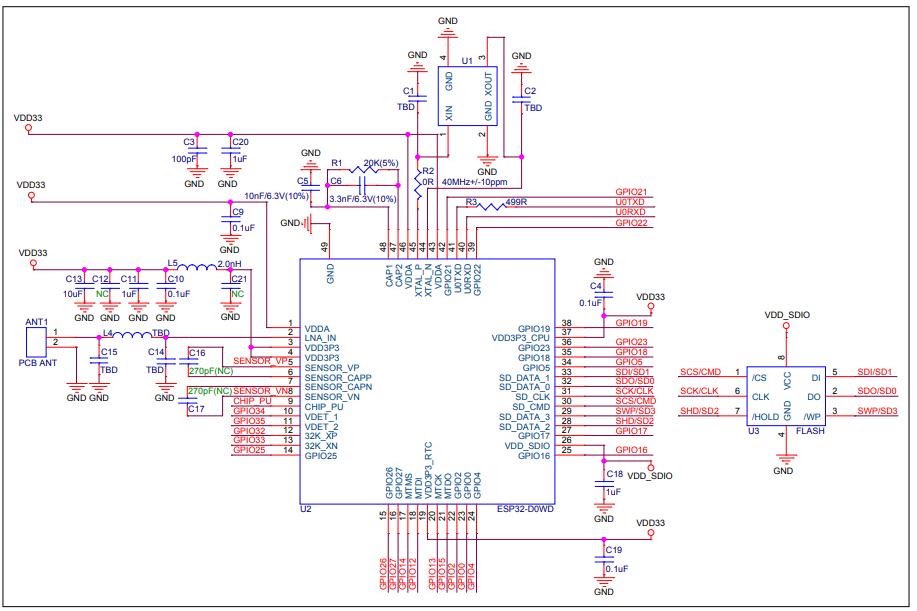
These are editorial plans, not published instructions or promised dates. They show where the learning path can go next.
A guided comparison of Matter over Wi-Fi and Matter over Thread, including commissioning and power measurements.
Capture, resize and classify images locally, then test accuracy, latency and PSRAM use.
Measure 2.4 GHz versus 5 GHz reach, congestion and reconnect behavior without claiming laboratory RF accuracy.
Create a camera-aware local dashboard and document why multimedia compute and wireless are split across chips.
Espressif’s newer 320 MHz dual-core RISC-V line combines Wi-Fi 6, BLE 5.4, Bluetooth Classic, 802.15.4 and richer HMI/AI acceleration. It entered mass production in 2026, but the ecosystem is younger than S3/C3.
Official product page ↗A new ultra-low-power BLE 5.4 + 802.15.4 family aimed at wearables, LE Audio and dense sensor networks. Samples were announced in March 2026, so H2 remains the clearer classroom Thread/Zigbee choice today.
Official sample announcement ↗Specifications and board status were checked against official Espressif material on 18 September 2026. Product pages and datasheets can change.
Filter current chips, modules and development boards.
Board variants, memory options and user guides.
Official toolchain and first-project workflow.
Power, reset, strapping, RF and PCB-layout rules.
Current official CP2102N/Micro-USB/AMS1117 reference circuit.
Official component placement and routing reference.
Official schematic, PCB, Gerber and BOM design package.
Pin use, power options and official reference-design links.
Do not assume every ESP32 family has the same security hardware.
Official current-status source for C5.
New 2026 high-performance integrated family to watch.
New low-power BLE/802.15.4 family; samples announced March 2026.
This guide compares the original ESP32, ESP32-S2, ESP32-S3, ESP32-C2 / ESP8684, ESP32-C3, ESP32-C5, ESP32-C6, ESP32-H2, and ESP32-P4 / P4X. They are not interchangeable:
Specifications and availability were checked against Espressif’s product selector, official development-kit catalog, and individual board guides on 18 September 2026. Always verify the exact ordering code because flash, PSRAM, pin exposure and connectors vary.
The interactive gallery contains thirteen build ideas with a recommended board, time band, core parts, learning advantage and board-specific reason:
The page preserves the original Academy4Tech ESP32-D0WD core schematic, but that legacy image contains TBD and NC component values and is not a complete manufacturing package. The new student reference instead starts with an ESP32-WROOM-32E module and separates USB-C input/protection, 3.3 V regulation, CH340C USB-to-UART programming, the automatic reset network, EN/BOOT recovery, module decoupling and breakout headers.
Before fabrication, compare the recreated circuit with Espressif’s current ESP32-DevKitC V4 schematic, official PCB layout, DevKitC user guide, ESP32 hardware-design guidelines, and the current ESP32-WROOM-32E datasheet. Run schematic ERC and PCB DRC, verify every physical footprint, respect the module antenna keepout, and order only a small first revision.
ESP32-C5 is a current mass-production dual-band option, while current P4X boards replace older early P4 hardware for advanced multimedia work. The newer ESP32-S31 combines a high-performance dual-core RISC-V CPU with a broad integrated radio set and richer HMI/AI features. ESP32-H4 samples were announced for next-generation ultra-low-power BLE and 802.15.4 devices. These newer families are included as a watchlist, not silently presented as the easiest student default.